

Welcome to Listening Between the Lines
If you’ve ever thought:
- “My hearing aids work but conversations are still exhausting.”
- “My cochlear implant restored my hearing but I still can’t understand people.”
- “I can hear people talking, but I miss parts of what they say.”
- “By the end of the day, I’m mentally drained from trying to keep up.”
You are not imagining it and you are not alone. Most people believe that once hearing devices are fitted, the hearing journey is complete. In reality, that’s often just the beginning.
Listening Between the Lines exists to help adults understand something rarely explained clearly:
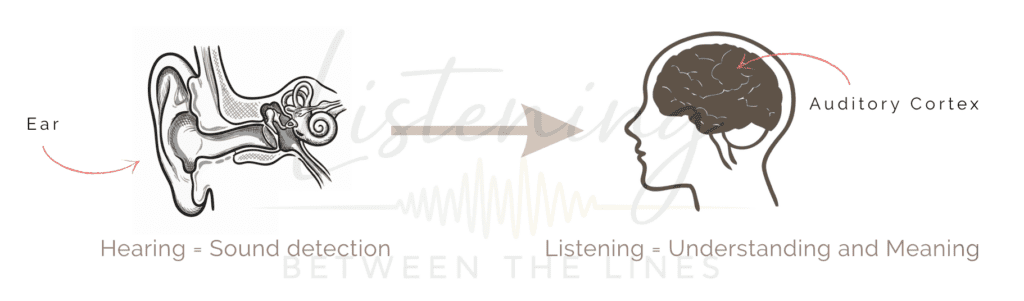
Hearing is about sound. Listening is about the brain.
Learning how listening works can completely change how you experience communication, energy, and confidence in everyday life.
The Gap No One Talks About in Hearing Care
Modern hearing technology is remarkable. Hearing aids and cochlear implants can restore access to sound that was previously unavailable. But many adults discover something surprising after receiving devices: They can hear more yet listening still feels hard. This happens because amplification improves audibility, not automatically listening efficiency.
In a clinical appointment, your audiologist measures important things like:
- How well you can detect soft sounds
- How clearly you understand speech
- How devices are programmed for your hearing profile
These tests are essential. They ensure sound is reaching your ears appropriately. What they cannot fully measure is:
- Mental effort during conversation
- Listening fatigue at the end of the day
- Difficulty in noisy environments
- Cognitive load during communication
- Confidence in real-world listening situations
This is where many people feel stuck and where education becomes powerful.
Hearing vs. Listening: What’s the Difference?
Think of hearing and listening as two parts of the same system.
Hearing happens in the ears. Sound enters, vibrations are detected, and signals travel to the brain.
Listening happens in the brain. The brain must:
- Filter background noise
- Focus attention
- Fill in missing information
- Interpret meaning
- Connect sound to memory and language
When hearing changes, the brain must work harder to accomplish these tasks.
Why Listening Can Feel So Exhausting
Many adults describe a type of fatigue they didn’t expect:
- Social gatherings feel draining
- Restaurants become stressful
- Group conversations require intense concentration
- Even enjoyable interactions can feel tiring
This isn’t a motivation problem or a technology failure. It’s a listening system adapting. Your brain is actively learning how to interpret sound differently often without guidance on how to support that process. Just as physical therapy helps the body adapt after an injury, aural rehabilitation helps support the listening system after hearing changes.
What Is Aural Rehabilitation — and Why Most People Never Receive It?
Aural rehabilitation is simply the process of learning strategies and skills that make listening easier in real life. Historically, it has been:
- Clinic-based
- Time-limited
- Difficult to access
- Underexplained to patients
Many adults never realize it exists. Listening Between the Lines was created to make these concepts understandable, approachable, and available outside of the clinic environment as education you can explore at your own pace and customizable to fit your specific listening profile and activities of daily living. This platform does not replace the clinical care provided by your audiologist or hearing care professional. Instead, it helps you better understand the listening experience itself.
What You’ll Find Here
This platform is designed as an educational guide to help you better understand your listening system through:
- Practical listening education
- Communication awareness
- Understanding listening fatigue
- Everyday listening concepts explained simply
- Tools to help you reflect on your own listening experience
You’ll begin with free educational blog posts like this one. From there, readers who want deeper structured learning can explore:
- Listening Foundations Lite — an introductory educational eBook
- Listening Foundations Core — a comprehensive self-guided learning experience
Each step builds understanding gradually, without overwhelm.
Why Education Changes the Listening Experience
Many people believe improvement only comes from changing technology. But often, improvement begins with understanding. When you understand why listening feels hard, how energy affects communication, and how the listening system adapts- you stop blaming yourself and start working with your listening system instead of against it. That shift alone can reduce frustration and increase confidence.
A Starting Point
If this resonates with you, you’re in the right place. Listening Between the Lines is here to help you understand the parts of hearing that exist between the test results and real life because better listening isn’t only about hearing more sound. It’s about learning how listening works.
To get started, the first ten pages of our Listening Foundations Lite eBook are available as a free download. It’s a starting point for understanding your auditory system, your rehabilitation process, and what realistic, sustainable progress looks like. For a most customized and guided approach to your listening, we offer 1:1 coaching sessions through our Listening Foundations Core- Guided Application program.
Download the Free Ebook Preview → Click Here
Not sure where your experience fits? Explore our Program Offerings to determine your best starting point.
— Dr. Ana | Audiologist & Founder, Listening Between the Lines


